
Digital Plasticine
and the monsters we make

16th-century Rabbi Judah Loew created the Golem of Prague to protect the community from Holy Roman Emperor and bloodthirsty asshat Rudolf II. He did this by fashioning a short waisted figure from the clay of the Vltava River and then animating it by placing a piece of parchment in its mouth that had a word written on it.
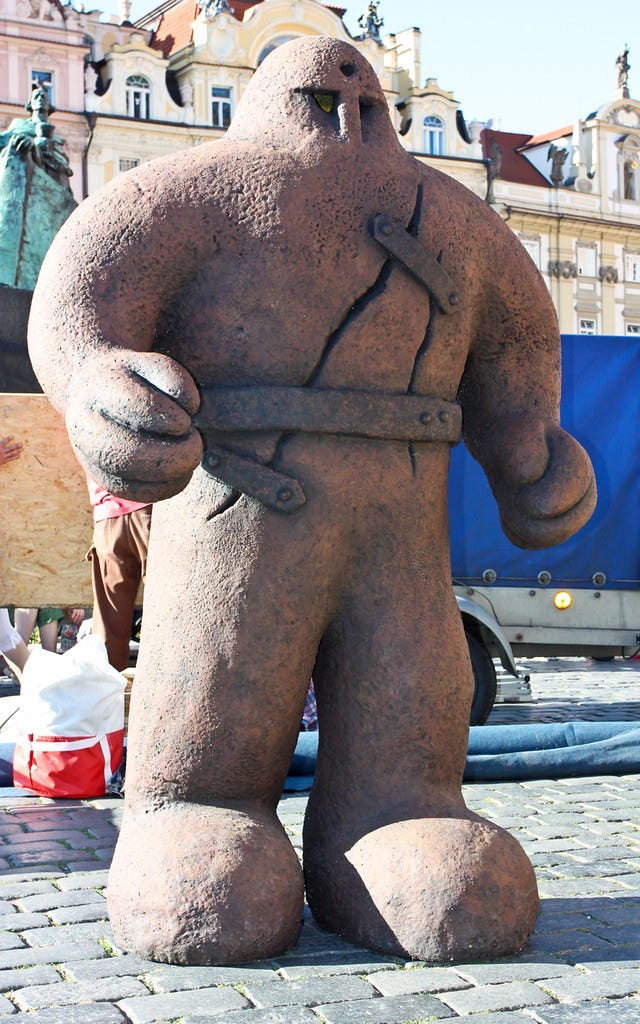
The Golem statue in Prague
The distinguishing characteristic of a golem is that it is animated by language rather than breath or spirit. This makes the golem obedient but mindless, prone to spinning out of control because it does not truly understand the world. Which is what happened to the Golem of Prague, who had to be decommissioned and stored as a pile of dust in an attic after it went wild on the streets and missed the Sabbath.
The golem analogy maps easily onto generative AI. A prompt, like a piece of parchment, animates the system. Words call images and actions into being, but they do not confer consciousness, intention, or a soul. Like AI-generated imagery, the golem is uncanny because it can produce the outward signs of action, but it is not alive.
I know what you’re thinking. The golem is not only related to AI but is a cautionary model for all technologies, in that technologies are made by humans and seem to work really well until they rampage, at which point they must be deactivated and shelved for the safety of humankind (but somehow never are, except in the movies.)
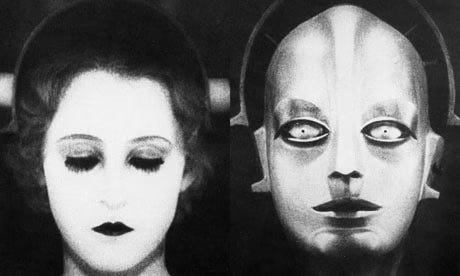
The False Maria robot in Fritz Lang’s 1927 Metropolis, the apes eschewing the lab for belted outfits with medallions and leather vests, gamma-ray mukbang from a mild-mannered scientist, the unspecified lizard that grows large with nuclear power and rises hangry from its tropical slumber.
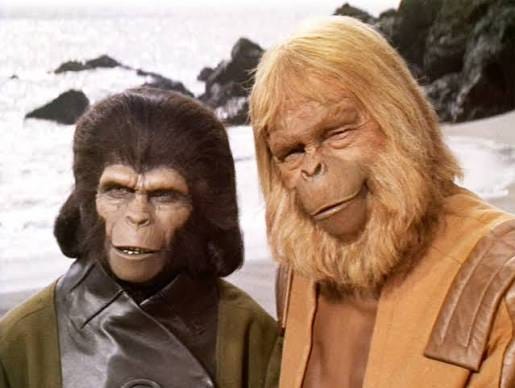

But with the golem and generative AI, it’s not just that it’s a potentially out of control, rudely mimetic, non-alive but alive-looking technology animated by words, it’s that it’s made out of mush.
Under the mental model of generative AI, slop is the mud. The monster here is extruded, undifferentiated, roughly shaped, smooth. Hand built, as the potters would say. All of culture mushed up like baby food and extruded into shapes that resemble the human form. AI slop is the plasticine of digital.
Contrast this to the language of CGI and VFX, which is anatomical and architectural. In those digital disciplines, artists build wireframes, animate skeletons, apply skins, and assemble layers. The vocabulary presents synthetic image-making as an orderly process of engineering. The project is about applying a thousand specialized hands onto the miracle of live action in such a clean way that the labour disappears into the photographic real. CGI is built in layers of flesh and mesh by teams of god-like specialists, like the team of doctors building the Six Million Dollar Man.
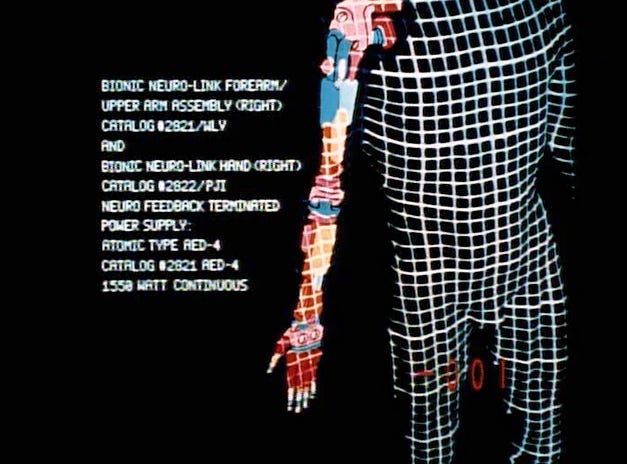
We can rebuild him.
Though CGI and AI-generated moving images share many underlying mechanics (no lens, no fixed take, images built from separable, recombinable operations rather than a single exposure, performance detached from any originating body), CGI is culturally imagined as a body painstakingly assembled by expert hands, whereas AI is imagined as amorphous, excessive, terrifying.
So just as the Golem of Prague is not a story about clay, this is not about the media forms themselves, but about the cultural story we tell when characterizing how it has been made. The term slop names a kind of unease with how the generative AI image comes into being, or maybe an unease with the idea that no one or nothing is answerable for it coming into being (training data without attribution, labour absorbed without credit, outputs for which no one appears fully answerable). We don’t like it when we can’t locate the hand behind the action, it reminds us of monsters.
It's also hard to find anyone to blame.
Interesting and insightful analogy. Personally, I had thought of Frankenstein, but perhaps a 'protective figure' is more suitable.